
The following is from a presentation by Marco Longo, MD at the International Association of Group Therapists’ annual congress in Malmo, Sweden on April 3, 2018.
Italy has a record number of earthquakes in Italy; the entire country is full of fault lines. I thought California was bad but there is no comparison. The country now has 250 earthquake detection sites that cover every risk area. Within 5-10 minutes, the site gives 1) the starting time, 2) geographic coordinates, 3) hypocentral coordinates and 4) magnitude.
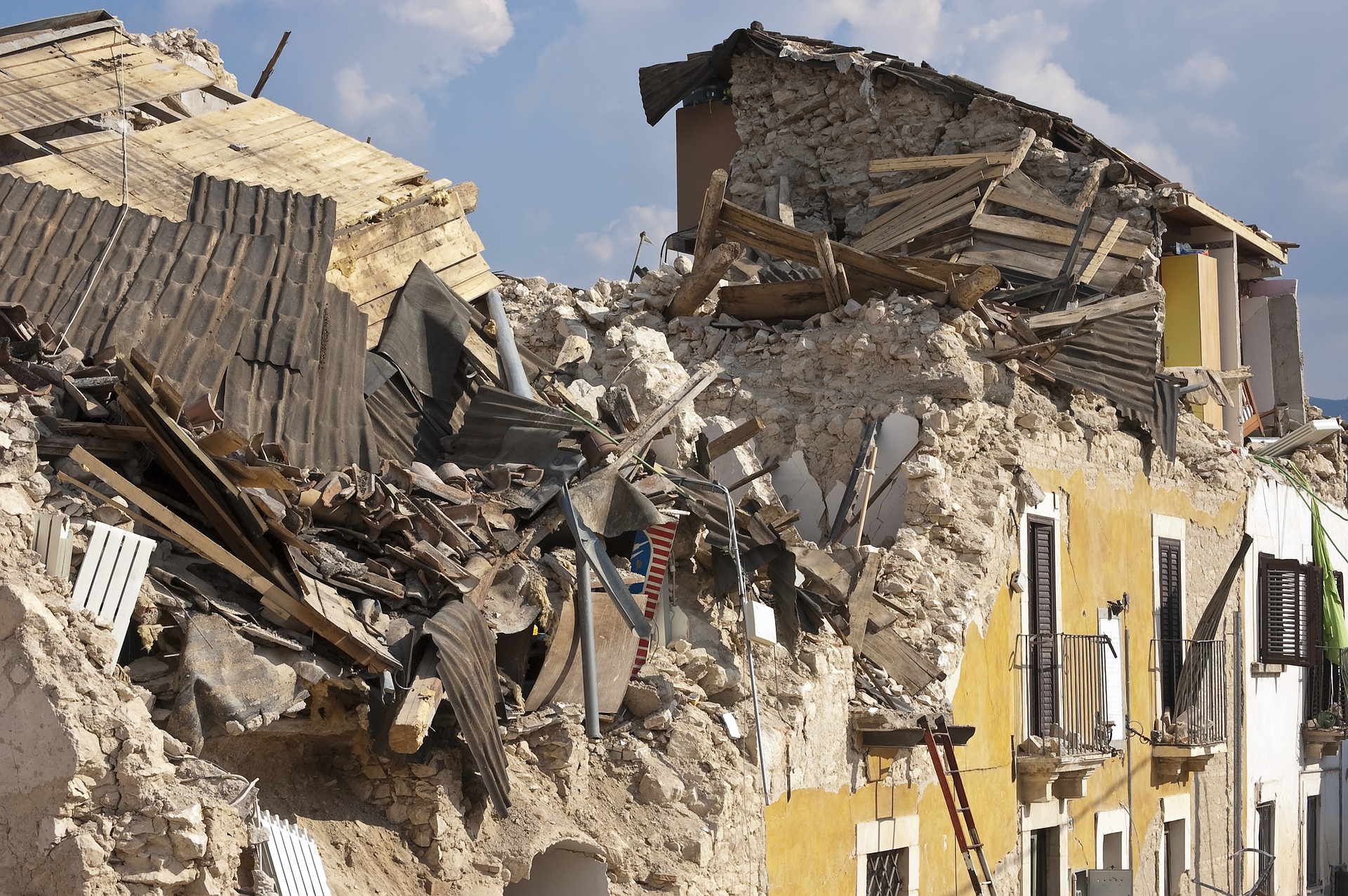
In the 21st century, there have already been 22 significant earthquakes. One of the more notable was 1963 in the Dolomites. There was a very large landslide and the water basin of a dam overflowed. All the inhabited settlements in the valley were destroyed. Marco Longo was a little boy and “struck by the fact that there was nothing (left) in the valley, except the floor of a church in Longarone, with only one big bell resting on it…visible for miles.” Witnessing this, Dr. Longo decided to devote his life to helping victims of disaster. He started his work as a volunteer and later as a psychiatrist.
Prior to 1992, earthquake relief was handled by government agencies, including the military. It was chaotic and money was spent on projects that were not helpful to many communities. A couple of the problems were that relief workers were not trained and scientists were not employed.
Severe tragedies continued; finally, with post-mortem dialogue, the National Civil Protection Service was formed. This agency now employs local authorities, private individuals, police forces, Red Cross, scientific engineers, architects, rescue corps and mental health workers trained in disaster relief (psycho-emergency). With local involvement and regard for language and culture, residents were less passive and more resilient.
In Mercalli, 2009, there was an earthquake where 334 people died and 75,000 were displaced, many in 250 camps. The NCPS strategy was tested. Dr. Longo shared this first experience. Dozens of volunteers came to help; residents were not only suffering the trauma of loss of their homes and property but also that of living in the camps. Dr. Longo was struck that volunteers were “too young or newborn” and once in the displacement camps “started a race to demonstrate each one the superiority of their (psychotherapy) intervention model.” In his presentation, he said managing this issue of competition was the hardest part of his job. In a further communication, he wrote: “It’s one of the most important goals, and also one of the hardest things to do, but it must be done.”
His efforts began by working on a training program for all mental health workers on the ground. The following critical tenets of training were presented in 2003 by Psychologists for the People’s, an Italian association of psycho-emergency (April).
Psycho-emergency training must include:
· Adequate and preventive analysis of personal motivations that push and/or lead to interventions in a critical situation;
· How to protect self and not put oneself at risk;
· How to maintain calm and attention;
· How to manage emotions;
· How to listen and tune in with others;
· How to collaborate respectfully without overlapping or precipitating conflict;
· How to maintain and use “internal setting” to allow adequate intervention with individual persons and group;
· How to manage every size group and community;
· Development of skills in using the psychosocial dimension of intervention.
Dr. Longo summarized: “Even when working with individuals, the intervention must overall consider the group and psychosocial matrices of each person…and so be primarily addressing psychosocial matrices of individual discomfort and not pathology of individual.”
An increasing number of disasters are occurring in the world; let’s learn from Italy’s experiences!!
REFERENCE:
Longo, Marco (2018), “The Evolution of the Social Intervention in Psycho-Emergency in Italy,” International Association of Group Therapists, Malmo, Sweden, August 3. 2009